Friday, May 17, 2013

Being a Tourist Part IV: The Great Wall of China


I learned something about The Great Wall of China while planning a recent trip there: isn't one wall. It is really a somewhat complicated network of walls built over a the period of a couple millennia. Different sections are in various states of repair, some are connected and others aren't. Each emperor who built walls did so according to the land he controlled and the people he didn't like (mostly the Mongols and Manchus.) The scale of the thing is awe inspiring.

Map courtesy of Wikipedia

The Chinese say you're not a real man until you've climbed the Great Wall. A little extra motivation to visit a wonder while it's still conveniently close. We had avoided trips like this last year due to the pregnancy and birth, so when my parents decided to come all the way from Illinois it was an easy decision to zip up to Beijing; the wall being the main attraction.


The Great Wall's effectiveness varied over the years with the northern invaders occupying China off and on. The luck ran out permanently at the end of the Ming dynasty after the emperor spent much effort to rebuild the wall. The Manchus of the northeast seized Beijing around 1644AD and established China's final dynasty: the Qing dynasty.


Something so old is bound to succumb to the elements over time; some areas no longer exist and the most recent sections are in the best shape. A handful of sections have been rebuilt and maintained as tourist areas. I learned from others that the Mutianyu section wasn't likely to be as crowded as other tourist areas because it was a little more difficult to access by giant tour buses that are common in China. Coupling that with the fact we went on a weekday and the place was quiet.
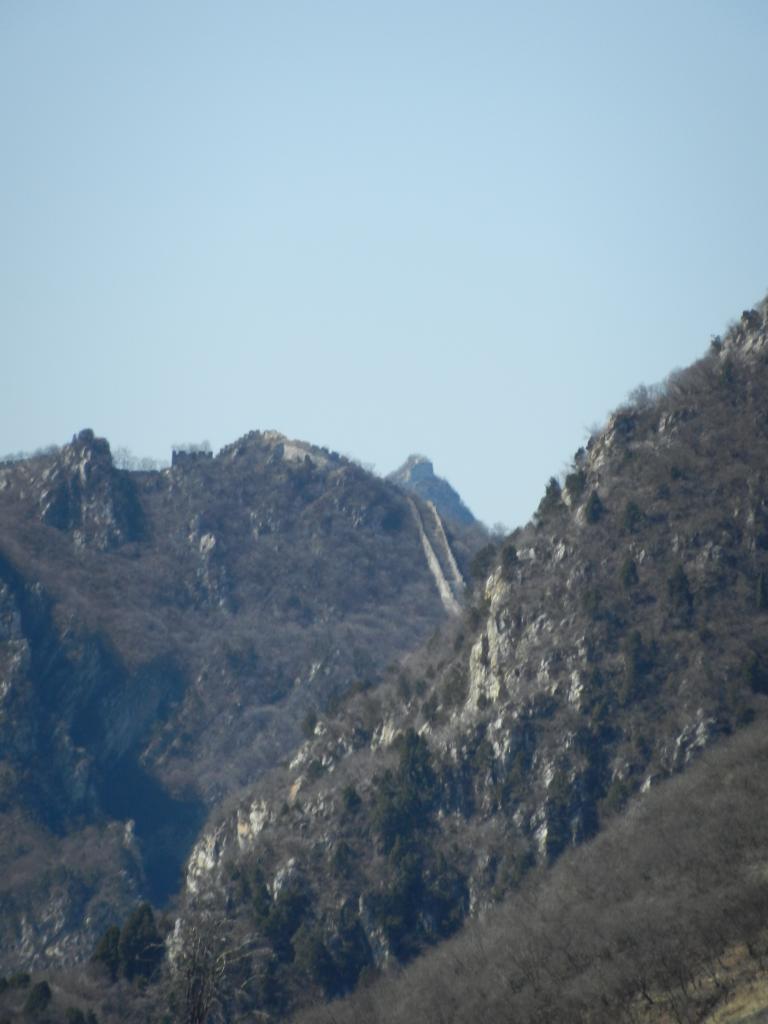
A section of unmaintained wall is barely visible with the camera set to "super zoom" mode.


Earlier walls were built by compressing earth between wooden barriers, but this area was built (or maybe rebuilt) by the Ming dynasty with stone and brick. Cement and mortar didn't exist, so they used sticky rice to hold the walls together. Modern reconstruction used mortar, loose pieces of which are often picked up by vandals looking to leave their chalky mark on history.


The wall at Mutianyu snakes along the mountain peaks and is surrounded by forest. Some sections of that wall are quite steep causing people to look silly.


One section in particular is a very steep and long staircase, at the top of which flew a Chinese flag. Just to get to the base of these stairs was a multiple hour trek and only four out of five party members made it that far...and one of the four was relying heavily on the kindness of others me to do the walking.

The flag flew at that first guard tower on that hill in the background.

Check the size of people to fully understand how high that flag was.

At the bottom of the stairs, a woman and her son came down counting each step. 410(ish) steps up to the flag, a few more if you wanted to mount the mountain peak. Dad and I made it up about 30-50 steps before calling it quits but Shayne stayed strong. A woman at the top took her picture.

Queen of the Mountain

Shayne carried the camera to the top to share what we missed. The view was really something - we lucked out with a pollution free day.

Shayne's view from the top
Mom making the most of the bottom view.


At a few places along the wall were constructed garrisons/watch towers/barracks. These were sort of interesting and most had a hole in the roof to climb through. The interiors had brick columns and arches supporting the heavy brick roof.

Dad spotting for Shayne, the first step is a doozy.


At Mutianyu there are three options to get to the wall. You can ride an enclosed gondola, you can take an open air ski lift or you can hike up by foot. The gondolas and ski lifts both cost money and take you to different locations. At first we took the gondola ride together and did our sight seeing. After we finished up, Shayne and I took the ski lift back up so that we could ride the toboggan back down.

Riding the gondola up to the wall
The toboggan is equiped with a "dead-man" safety system. What that means is that the brakes are engaged by default, so if you do nothing it will stop. To make the toboggan go faster, you have to lean forward and push on a lever. The trip was pretty exciting until I got stuck behind a nervous slow-goer.


We've lived here long enough to know that warning signs are to be taken seriously. It's not like the US where warning signs are used to warn you about things that aren't really dangerous like hot coffee and pinch points. In China, if there is a warning sign you better pay attention because your life may be on the line.


Shayne doing the Chinese girl pose


And for scrolling all the way to the bottom, here is your reward:


Sunday, May 5, 2013

Being a Tourist Part III: Tiananmen Square and Temple of Heaven

While in Beijing we also visited Tiananmen Square. I won't write too much about it, but if you are interested here is a link to some info: https://en.wikipedia.org/wiki/Tiananmen_Square

We only stayed long enough to snap a few pictures as it was windy and the Chairmen Mao mausoleum, where you can view his body, had closed for the day. For all those who follow us, it closes at noon...don't be late.

To be honest, there wasn't much in English and I didn't do any studying ahead of time, so I don't know much of anything about the monuments.


So close to seeing a preserved human being.


Later in the afternoon we strolled through The Temple of Heaven.  This was the site where emperors of the Ming and Qing dynasties held ceremonies and offerings for good harvests. Once again, no tour guide so we didn't know much about what we saw, so here is a sample of the sights!

I think they just about covered all their bases.

With some 40,000 characters in the Chinese language I suppose it is easy to fall out of practice!

Pots for burning the offerings.

Snug as a bug in a rug!


Near catastrophe when I decided to touch this only to find out it wasn't attached. Luckily, I caught it before it dropped to the ground and broke into a million little pieces. Phew! That would have been embarrassing!
 The following are a couple of the structures where ceremonies would take place.


After a long day  of touring we needed to fill our bellies. When in China, why not visit Tim's Texas BBQ???


Someone had a bad case of hat hair!


Next up....The Great Wall!

Wednesday, April 24, 2013

Being a Tourist Part II: After Dark

We ventured out one night in Beijing to see what happens after dark on Wangfujing Street. Usually nothing good happens after a certain time at night, and Beijing is no different. We chose to avoid trouble and had a good time.

About $4 gets you a taste. Pictures are free...if you're quick.

Mom pretended she didn't want to shop, but then she saw this alley and Dad's wallet came out.

If you don't like the price, walk away. They got the same stuff next door.
This was her first taste of bargaining, and she did pretty good but maybe left some money on the table. By the end of their visit she had it all figured out though. After she had her fill of China souvenirs, we found a street specializing in street food. They had everything from scorpion on a stick to simple dumplings. Truly something for everyone, but we were all stuffed full of Beijing duck from earlier in the night.


Near the hotel was a church, and in front of that church everyone was gathered doing everything. There was a choir singing hymns, a soloist singing opera, ballroom dancers and some hooligans practicing their break dancing. Unfortunately, none of those pictures turned out due to low light. You'll just have to use your imagination about a place where those things are all happening in close quarters.


Monday, April 22, 2013

Being a Tourist Part I: First Stop Beijing

We have been in China for over a year and had yet to do much touring outside of Suzhou, so when our first visitors arrived we crammed as much site-seeing in as we could.  Our adventure started out on the high-speed train to Beijing.

China is crowded. You have to catch a ride anyway you can.

Our first stop in Beijing was The Windy Forbidden City. If you are looking to read a plethora of interesting facts you may be disappointed to know I, Shayne, have decide to write this post and I am not always the best listener. The way I remember it our tour guide spent most of her time talking about the Emperor's concubines, so you may want to set your expectations low in regards to how much you are going to learn about this imperial palace built by the Han Dynasty. No.  Qing? No that wasn't it either. Qin? Ming. It was definitely the Ming Dynasty (I barely made it through US history, I have no idea how the Chinese do it).

The Palace was pretty impressive. We came no where near viewing the entire site. Our guide suggested spending two to three days there if you want to see it all. The complex is made up of 980 buildings and 8,886 rooms. Though if you ask the emperor he believed there to be 9,999 rooms. Shh....don't tell.

 
The view of the first courtyard after entering through the south gate.


Most of the roofs were painted gold. We were told the original paint was made with actual gold. Fancy.


The Palace consisted of multiple courtyards. In the centers were structures that each served a specific function. Some of these include a building for conducting business and ceremonies, the Emperor's living quarters, the Empress's living quarters (Evidently they are only friendly once a month to make babies, otherwise the Emperor is all about his concubines. Interesting, no?), the Empress's birthday building and, of course, the living quarters of the concubines. The courtyards were surrounded by much smaller rooms that were used for various officers for conducting daily life.

I'm on a moat.
 All around the courtyard were these huge vats. They were used to collect rain water.  The rain water could then be used to douse any fires in the all wood palace.


In one ear. Out the other.
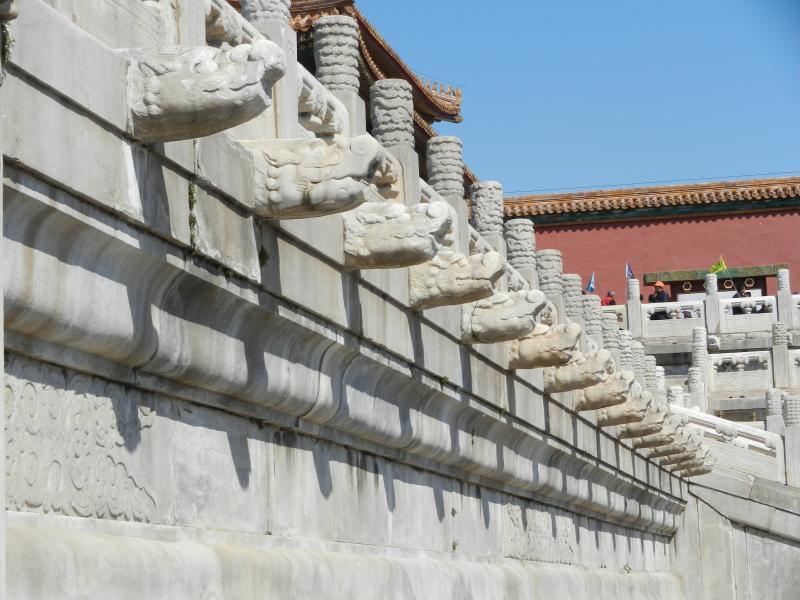
The Palace had an interesting drainage system. These dragons each had a spout. The water would pour out, seep into the ground, and hopefully help keep the moat full.


The Empress and her iPad.

This didn't have to do with the concubines, so I can't remember much other than I believe we were told it was carved from one solid piece of stone.

There is no evidence Clif attended this outing according all the pictures we he took. Oops.
 Important people liked odd numbers. In many places you will find these little animals on the roofs. If there are nine, the person living inside must be important. However, the number ten was used only for the divine.


These lions were also guarding important buildings. We were told if they had five toes they were guarding an important person. These have four toes and also the ears are turned down. If I recall correctly, the turned down ears had to do with them being in front of structure for the Empress. It made them less furious. 

Restored and beautiful.

A view of the outer structure.

There were many kinds of incenses burners. There were large ones burned during ceremonies and smaller ones, which I am assuming were more for every day use. Interest fact: sometimes a concubine might try to add poison to an incenses burner like pictured below in an attempt to kill another concubine.


What I also found interesting that the last man chosen to be Emperor during the Qing Dynasty was actually a three year old boy. The guide told us at his coronation he was escorted by his father. The young boy was frightened by the noise of the ceremony and crying unconsolably. His father was over heard telling him not to worry because it would all be over soon. Ironically, that was true. Four years after he became ruler the Qing Dynasty was over thrown. I am also pretty sure she told us this story because M may have been have a little fit in the baby-backpack.

The Gerke's meeting the last living nephew of the last emperor. He now sells his calligraphy to benefit the City, they bought one like you see hanging in the rear.


The final time I will mention them, we were also told each night the emperor would choose which concubine to spend the night with. His eunuch would then go to retrieve her. She would be required to take off all her clothes and be covered with a sheet. She would then be escorted to the emperor and he would know that she was not hiding any sort of weapon that could be used to kill him.

After our tour ended we walked back through the City only to realize what a maze of buildings we had not seen, including a four star bathroom.  It is truly an impressive site.


Stay tuned for more Beijing adventure!