Friday, August 30, 2013

Being a Tourist Part VI: Terracotta Army


What? We have a blog? Sorry it's been a while and we're behind...we left everyone hanging in Xi'An...

The terracotta warriors were discovered in 1974 by a group of farmers digging a well. The warriors, chariots and horses were buried with the Qin emperor around 210BC and are meant to protect the emperor in the afterlife. The Qin dynasty is said to be the first time all the warring states were united as a single "China," and this is the tomb of the man who did it.

Scale model showing the potential for a huge army

It is estimated that in the three "pits" there were over 8,000 soldiers, 130 chariots with 520 horses and 150 cavalry horses. Most of the artifacts have yet to be uncovered; the government has halted all new excavation until discovering a way to preserve the bright colors, which were painted on the warriors but disappears quickly after being unearthed now.


Pit One

In this pit the warriors have all been uncovered and many reassembled, it was the first pit discovered and contains around 6000 warriors. Originally, the warriors were painted with vibrant colors and held weapons. There were also wooden chariots behind many of the horses, but of course the wood did not survive. As you can imagine most everything was in pieces when it was unearthed. All of the pieces go to the "warrior hospital" as our guide called it to be pieced and glued back together. Then they were reset in the current formation.


A sign marking the location of the well, where pottery fragments were found in 1974


Each statue is life-sized and no one is like any other
An open pit that has not had the contents extracted and rebuilt


A mock-up of the "hospital." Our guide told us all of the actually assembling takes place somewhere else.

This is one of the few still showing original color: red at the knee area.

Nearly ready to be released
Much of pit two has been uncovered, but not rebuilt like in pit one. Part of this pit also has the rements of the wooden ceiling that was covered with reeds and buried deep under ground. Underneath these roofs is where they would expect to find more warriors. Here there is evidence of fire that took place in the tomb during the peasant uprising that began the Han dynasty.

Pit two

You can see the wood ceiling has sagged but not collapsed.

On to pit three...Here there are nowhere near the number of warriors, but this was thought to be the command post with walls, corridors and offices. The warriors were arranged not in a defensive posture, rather they were lined up as if watching a procession.


There was only one warrior that has been uncovered totally intact.
His kneeling position gave an advantage when the wood ceiling collapsed.

A high ranking officer


This trip was definitely one of the highlights of our time here in China. If you come to China is it a must see!

Wednesday, May 22, 2013

Being a Tourist Part V: Xi'an's Lesser Sights


We arrived in Xi'an at lunch time, and grabbed a quick lunch at the Hilton before heading out for some light sight-seeing. The Xi'an Hilton, by the way, is newly constructed and very, very nice. The main attraction in Xi'an is the 2000 year old Terracotta Warriors, but we'd schedule that for the second day. First on the agenda was the city wall, which follows the city's original boundary.


We'd gotten a tip the wall was an interesting way to kill a few hours. On top of the wall you can rent bicycles or golf carts to ride around the entire wall. We opted for walking and strolled leisurely for a bit along the southern side of the city.


We decided the wall really wasn't very interesting. It was an old wall that had originally been built 400 years ago, but had obviously been rebuilt recently. None the less, we successfully killed a few hours but regretted ignoring the guides advice to check out Muslim Street.


Rafael was our tour guide, we'd chosen him based on a reference from friends. Turns out he runs a tour guide company with multiple guides, drivers and vans. I can't speak for his other guides, but Rafael's English was good and his knowledge about Xi'an was fantastic. Miriam thought he had an interesting yellow badge on his shirt.


On the wall was a small bicycle museum with some very interesting examples from the history of bikes in China. The museum wasn't very big, but was certainly interesting to me.


There was also a hat salesman who capitalized on our being ill prepared for hot sunny weather. Shayne purchased enough shade for two people.


After the wall and a quick nap, we headed off for dinner at the Tang Palace Dance Show.


The show was really interesting with multiple performances of various traditional Chinese styles. It reminded me of the performances we saw last year at the Master of Nets Garden in Suzhou. However this show had a much larger budget.


The dinner on the other hand left something to be desired. Chinese dumplings are good - as long as they're served as part of a larger and much more assorted spread. However, and this dinner was dumplings and only dumplings. Granted, they were stuffed with a variety of stuffs but dumplings are dumplings and it got old pretty quick. I guess the large show budget is augmented by serving cheap food.


Perhaps the highlight of the evening was when we tried to get a refill on our Sprite. None of the waitresses could be bothered with it, so Mom got up, went to the waitress station and grabbed the bottle. We refilled and set it on the table like we saw on other tables, but soon someone came and took it back. Then the manager came and tried to sell us the bottle, while he tried to avoid looking annoyed....apparently they operate on the drug dealer business model. The first taste is free, after that it'll cost you.


After that we were all completely knackered, in fact Shayne took MJ back to the hotel early and missed the show. This was the fourth straight day of heavy tourism and we weren't done yet. The next day was reserved for the terracotta warriors.

Friday, May 17, 2013

Being a Tourist Part IV: The Great Wall of China


I learned something about The Great Wall of China while planning a recent trip there: isn't one wall. It is really a somewhat complicated network of walls built over a the period of a couple millennia. Different sections are in various states of repair, some are connected and others aren't. Each emperor who built walls did so according to the land he controlled and the people he didn't like (mostly the Mongols and Manchus.) The scale of the thing is awe inspiring.

Map courtesy of Wikipedia

The Chinese say you're not a real man until you've climbed the Great Wall. A little extra motivation to visit a wonder while it's still conveniently close. We had avoided trips like this last year due to the pregnancy and birth, so when my parents decided to come all the way from Illinois it was an easy decision to zip up to Beijing; the wall being the main attraction.


The Great Wall's effectiveness varied over the years with the northern invaders occupying China off and on. The luck ran out permanently at the end of the Ming dynasty after the emperor spent much effort to rebuild the wall. The Manchus of the northeast seized Beijing around 1644AD and established China's final dynasty: the Qing dynasty.


Something so old is bound to succumb to the elements over time; some areas no longer exist and the most recent sections are in the best shape. A handful of sections have been rebuilt and maintained as tourist areas. I learned from others that the Mutianyu section wasn't likely to be as crowded as other tourist areas because it was a little more difficult to access by giant tour buses that are common in China. Coupling that with the fact we went on a weekday and the place was quiet.

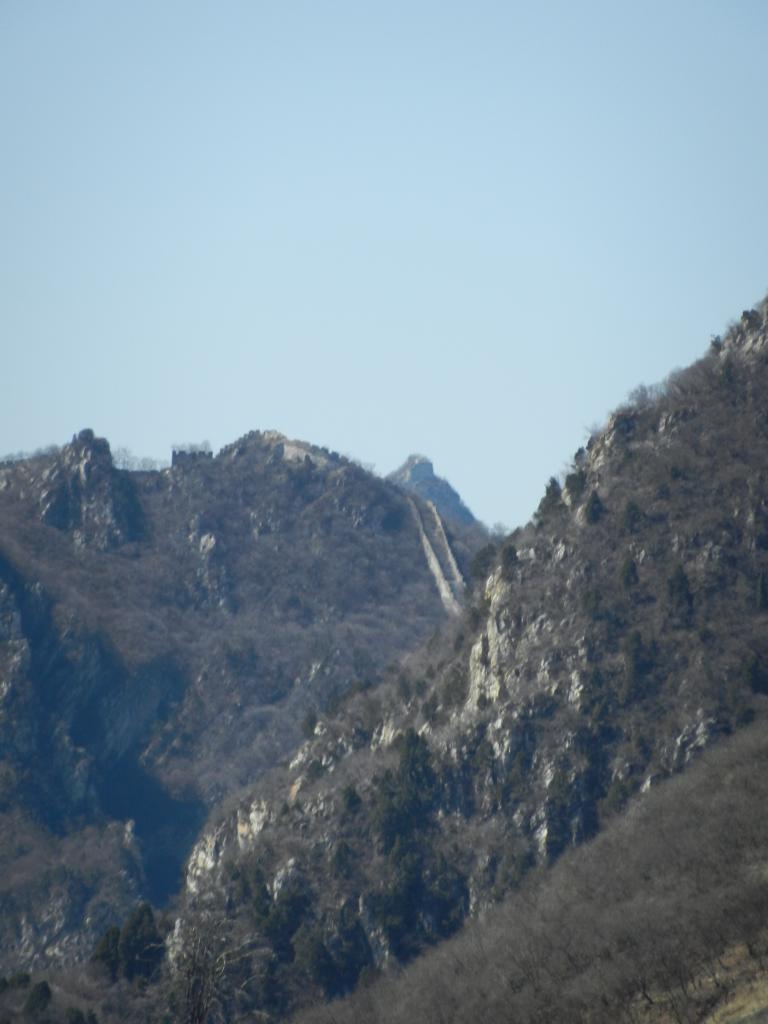
A section of unmaintained wall is barely visible with the camera set to "super zoom" mode.


Earlier walls were built by compressing earth between wooden barriers, but this area was built (or maybe rebuilt) by the Ming dynasty with stone and brick. Cement and mortar didn't exist, so they used sticky rice to hold the walls together. Modern reconstruction used mortar, loose pieces of which are often picked up by vandals looking to leave their chalky mark on history.


The wall at Mutianyu snakes along the mountain peaks and is surrounded by forest. Some sections of that wall are quite steep causing people to look silly.


One section in particular is a very steep and long staircase, at the top of which flew a Chinese flag. Just to get to the base of these stairs was a multiple hour trek and only four out of five party members made it that far...and one of the four was relying heavily on the kindness of others me to do the walking.

The flag flew at that first guard tower on that hill in the background.

Check the size of people to fully understand how high that flag was.

At the bottom of the stairs, a woman and her son came down counting each step. 410(ish) steps up to the flag, a few more if you wanted to mount the mountain peak. Dad and I made it up about 30-50 steps before calling it quits but Shayne stayed strong. A woman at the top took her picture.

Queen of the Mountain

Shayne carried the camera to the top to share what we missed. The view was really something - we lucked out with a pollution free day.

Shayne's view from the top
Mom making the most of the bottom view.


At a few places along the wall were constructed garrisons/watch towers/barracks. These were sort of interesting and most had a hole in the roof to climb through. The interiors had brick columns and arches supporting the heavy brick roof.

Dad spotting for Shayne, the first step is a doozy.


At Mutianyu there are three options to get to the wall. You can ride an enclosed gondola, you can take an open air ski lift or you can hike up by foot. The gondolas and ski lifts both cost money and take you to different locations. At first we took the gondola ride together and did our sight seeing. After we finished up, Shayne and I took the ski lift back up so that we could ride the toboggan back down.

Riding the gondola up to the wall
The toboggan is equiped with a "dead-man" safety system. What that means is that the brakes are engaged by default, so if you do nothing it will stop. To make the toboggan go faster, you have to lean forward and push on a lever. The trip was pretty exciting until I got stuck behind a nervous slow-goer.


We've lived here long enough to know that warning signs are to be taken seriously. It's not like the US where warning signs are used to warn you about things that aren't really dangerous like hot coffee and pinch points. In China, if there is a warning sign you better pay attention because your life may be on the line.


Shayne doing the Chinese girl pose


And for scrolling all the way to the bottom, here is your reward: